A SpaceX rocket that's been drifting through space for a year and a half, its fuel tank long since dry, will slam into the Moon's western near side early Wednesday morning at seven times the speed of sound. Nobody planned this impact — it's purely the result of a fuel miscalculation — but that accident has now become firsthand material for scientists studying the safety of future lunar bases.
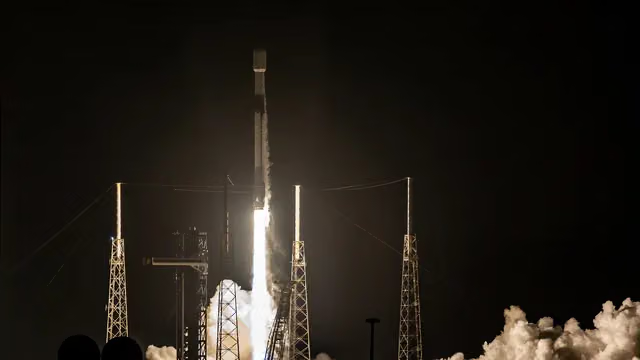
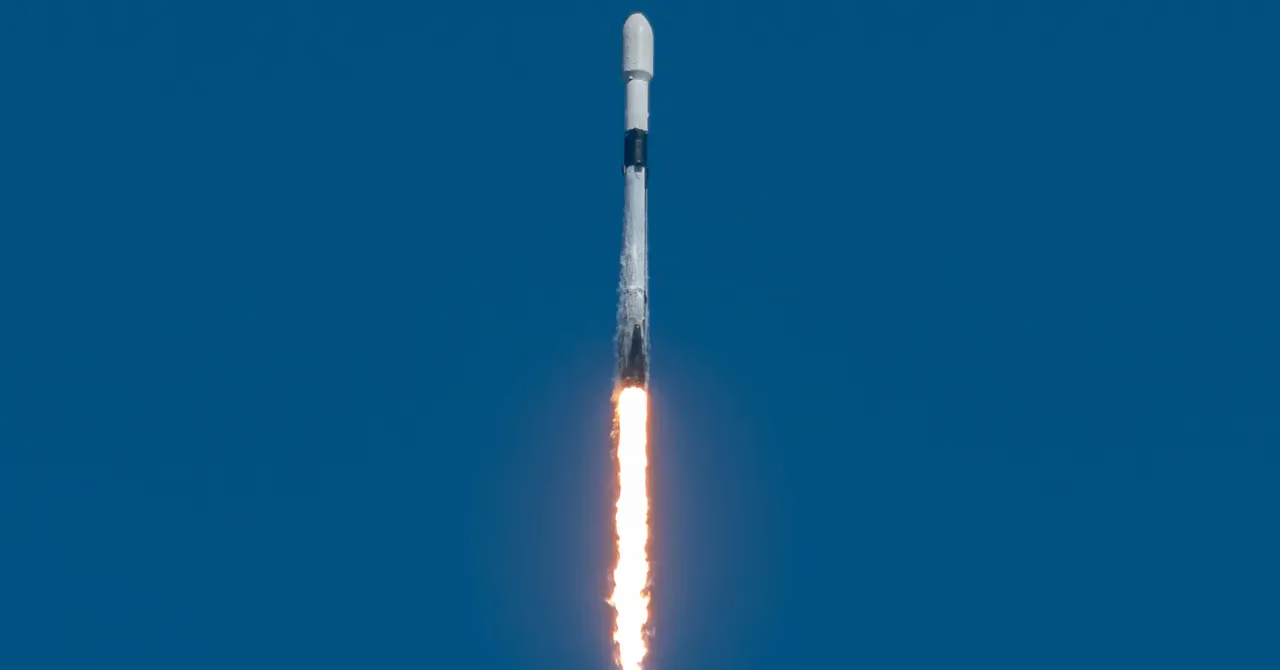
This Falcon 9 upper stage was once responsible for delivering a pair of lunar landers to the Moon's surface. The landers touched down successfully, but the rocket itself was left stranded: not enough fuel to return to Earth, and not enough to settle into a stable orbit. So it drifted through space for 18 months until gravity finally pulled it toward the Moon.
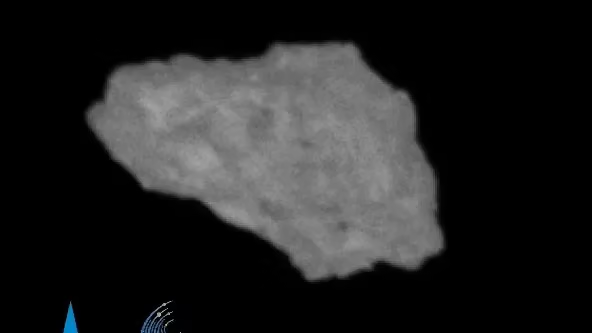
The impact will occur at 6:34 AM UTC on Wednesday, near Einstein Crater, with the Americas offering the best vantage point for observation. The rocket weighs 4 metric tons and will hit at roughly 5,400 miles per hour. With no atmosphere on the Moon to cushion the blow, the resulting explosion will pack the equivalent force of 3 tons of TNT, expected to carve out a crater up to 27 meters wide and 5 meters deep. The impact won't be visible to the naked eye, but through a decent telescope, observers should be able to catch a debris plume lasting several minutes.
This isn't the first time the Moon has taken an unplanned hit. In March 2022, a Chinese Long March 3C rocket body crashed into the lunar surface, leaving behind a 29-meter-wide crater. The difference this time is that someone calculated the trajectory in advance — Bill Gray, founder of Project Pluto, was the first to work out this Falcon 9's impact path, and he co-authored a preprint study published last month that turned this accident into a predictable, observable experiment.
The research team is treating the impact as a testing opportunity to develop methods for "measuring flash characteristics and pinpointing impact events via seismic signals." The goal is straightforward: if bases are ever actually built on the Moon, the threat posed by falling space debris needs to be quantified first.
Benjamin Fernando, a researcher at Los Alamos National Laboratory and co-author of the paper, told ABC News that these kinds of events will only become more frequent as more astronauts and infrastructure appear on the lunar surface. "We need to understand just how much risk these impact events actually pose," he said. He broke the risk down into two layers: one is the direct danger of being struck by debris or having your vision damaged by the flash of impact; the other is more subtle — the debris cloud kicked up by an impact could interfere with spacecraft operating in lunar orbit.
NASA's Artemis program is expected to begin missions to build lunar facilities within the next few years, but a research station capable of sustaining long-term human habitation on the Moon is still at least a decade away. That gap gives scientists a window — while lunar bases remain on the drawing board — to work out variables like debris impacts before it's too late.