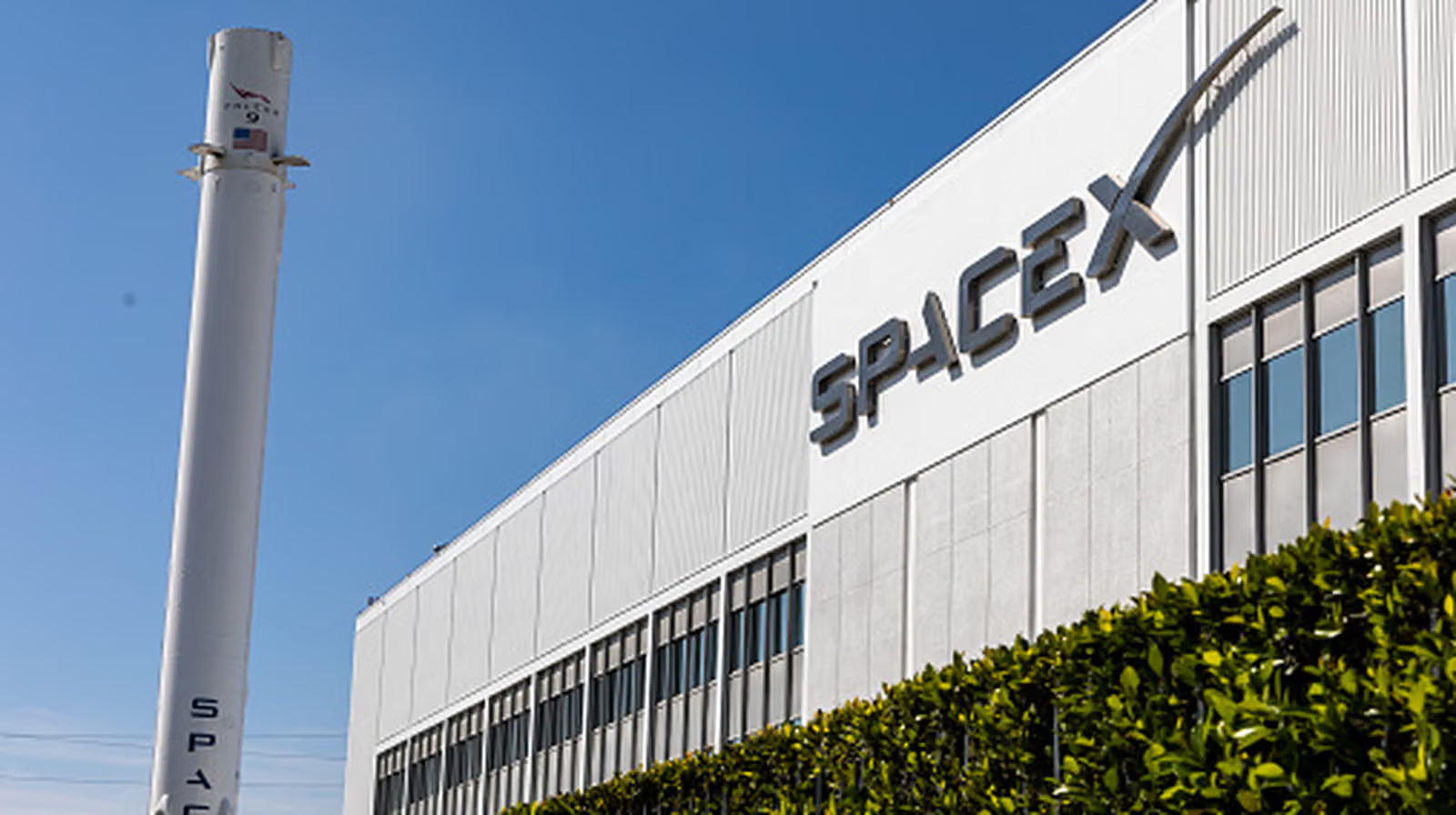
Nobody actually saw it happen. A four-ton Falcon 9 upper stage slammed into the lunar surface at roughly 5,400 mph, with no livestream, no warning, and no fanfare — until South Korea's space agency (KASA) released a set of "after-the-fact" images that confirmed it had, in fact, gone down.
The images came from South Korea's lunar orbiter Danuri. In an X post on August 6, KASA explained that the spacecraft, which launched toward the Moon on August 5, 2022, happened to capture footage of the Falcon 9 upper stage impact site both before and after the collision — in the early hours of August 5, 2026, exactly four years to the day since its launch. KASA also clarified that a separate "impact video" circulating online was not actually shot by Danuri; what Danuri captured were before-and-after observation images, not footage of the impact moment itself.
NASA estimates the collision left behind a crater roughly 60 feet wide and 12 feet deep on the lunar surface. Meteorite strikes hit the Moon constantly, so that part isn't unusual — but impacts caused by man-made objects are far rarer, which is why NASA framed the event as an opportunity for "valuable observation." Studying how the ejected debris scattered could reveal new details about lunar geology, potentially useful for future missions.
The rocket's actual mission had wrapped up two years earlier. The Falcon 9 had been in orbit since January 2025, tasked with sending two lunar landers into transfer orbit as part of the Blue Ghost program. The first-stage booster had long since successfully returned to Earth, but the upper stage remained in space, its job not technically complete until the landers reached their destination.
SpaceX addressed the reasoning behind this in a post on X after the impact: "For most missions, we plan for a controlled deorbit of the Falcon second stage so it splashes down safely in the ocean. But for high-energy missions like lunar transfer orbits, nearly all of the vehicle's performance is used just to get the payload into its intended trajectory, so a controlled disposal maneuver isn't always feasible." In other words, this wasn't an accident — it's simply that the mission design never left room for that kind of cleanup.
The impact poses no threat to Earth, but a comment from Cambridge astronomer Matt Bothwell to the BBC points to something more worth paying attention to than the crater itself: "Within decades, space could get so crowded that it becomes difficult to fly beyond Earth's orbit." A single 60-foot crater won't change much on its own — but if every mission leaves a rocket drifting in orbit or on the lunar surface, the accumulation is where the real problem lies.
Information for this article comes from Engadget's reporting and KASA's official social media posts. The impact occurred in the early hours of August 5, 2026, with KASA releasing the images on August 6.