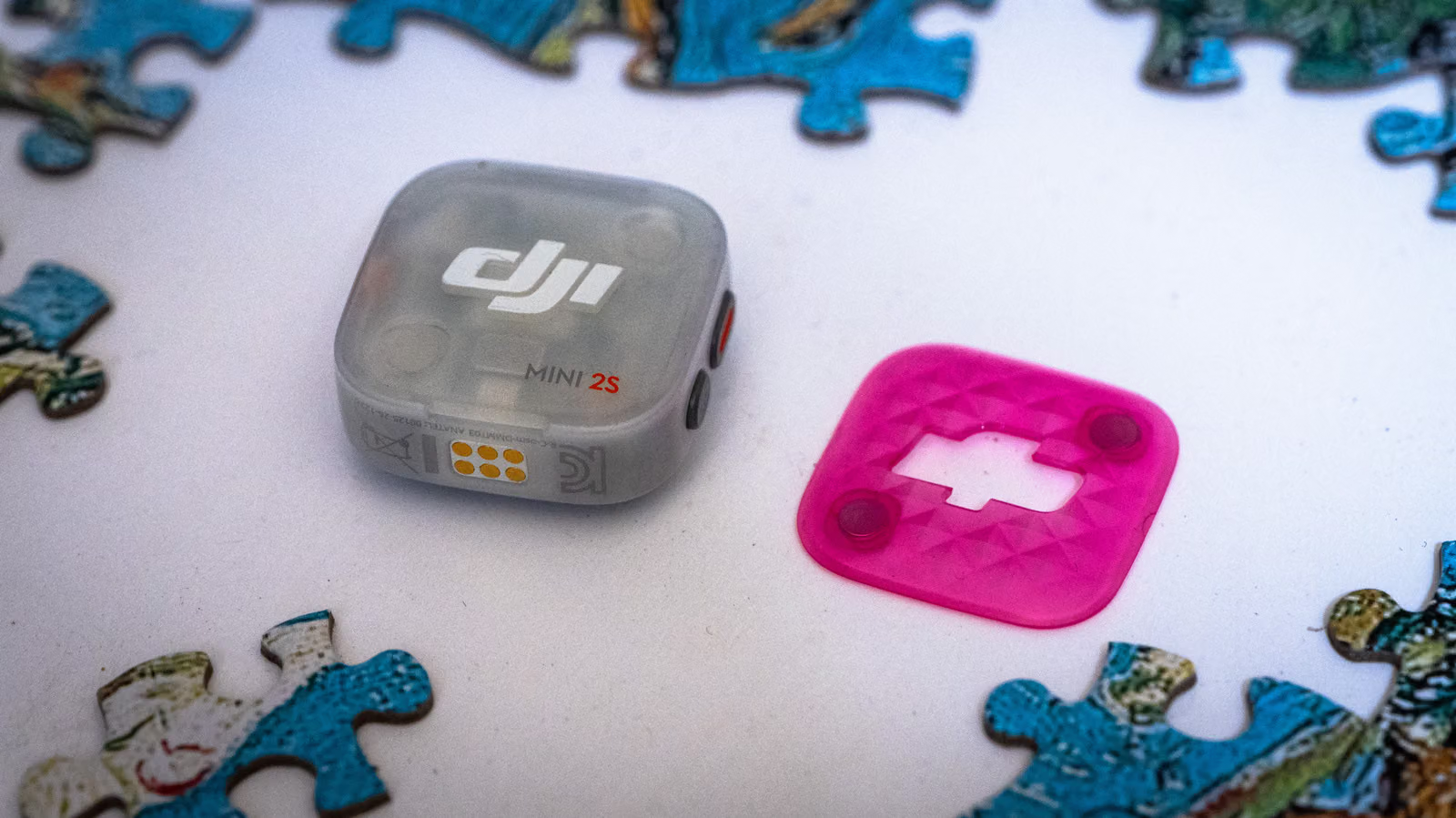
One press of the orange power button starts recording; press again to stop. That's the dead-simple logic behind the DJI Mic Mini 2S, and it's exactly why the entire Mini series took off in the first place — cheap, easy to use, and clean-sounding audio. But this time, what's actually got pro users paying attention isn't the operation. It's the 14.5GB of internal storage now crammed into the body.
The Mini 2S transmitter weighs just 1 gram more than its predecessor, landing at 12 grams, and that extra weight went entirely toward onboard recording: up to 28 hours of 24-bit audio, or roughly 22 hours at 32-bit float. In the past, the biggest reason pros skipped the Mic Mini series was the lack of a built-in backup recording — if the wireless signal dropped, your on-location audio was simply gone. Now that 32-bit float internal recording is here, it patches the single biggest safety hole in the whole series.
Engadget's Steve Dent ran a straightforward test: he deliberately blew out the input levels on both the Mini 2S and a Panasonic S1R II camera while recording. The camera's audio clipped hard and was completely unusable, as expected — but the 32-bit float internal recording, once brought into DaVinci Resolve Studio and adjusted, came out clean with no distortion. That's the whole point of 32-bit float: it's not about making audio sound better, it's about making "I blew the take" a fixable problem instead of a fatal one.
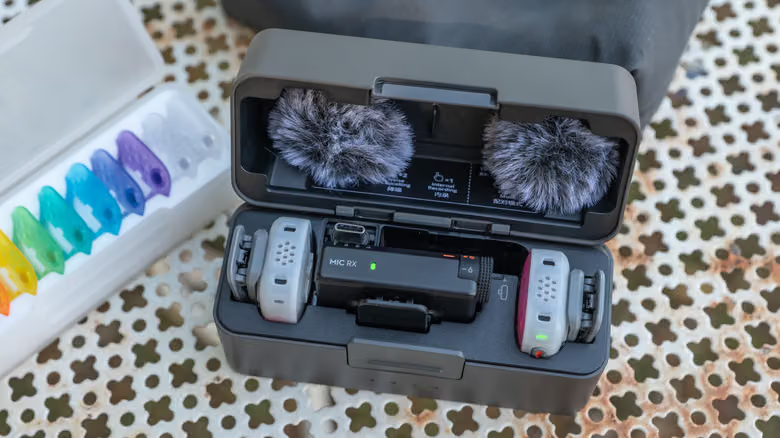
The Mini 2S also bumps the number of simultaneously connected transmitters from 2 to 4, and the receiver now has four numbered LEDs showing connection status — bringing it in line with the flagship Mic 3's multi-track recording logic. That said, compared to the Mic 3, the Mini 2S's receiver lacks a color screen for showing levels and other info, and its internal storage is less than half of the Mic 3's — a line DJI drew on purpose to keep the product lineup distinct.
There are still two kit configurations: the Camera Kit includes a receiver with 3.5mm output plus cable, two transmitters, and a charging case; the Mobile Kit includes a USB-C receiver, a single transmitter, and a charging case. Battery life dips slightly — 11 hours per charge for the transmitter and 10 hours for the receiver, both about 30 minutes less than the previous generation — but Dent's real-world testing at room temperature had both units running close to 10 hours, roughly matching DJI's official numbers. The charging case can recharge the whole kit 3.2 times, adding up to over 40 hours of total use, which beats out the Rode Wireless Go III and Hollyland Lark M2 at a similar price point.
Operation-wise, the Mini 2S stays true to the series' foolproof design: clip or magnet-mount the transmitter onto your subject, plug the receiver into your camera or directly into your phone, and after auto-pairing, just twist the dial to set levels and you're done. Switching between mono and stereo is as simple as double-tapping the link button. If you're using all 4 transmitters and want independent tracks for each, you'll need to enable internal recording on each one separately. For more advanced settings, you'll need the DJI Mimo app: there's a 32-bit float toggle, loop recording that auto-overwrites the oldest file once storage fills up, adaptive gain that automatically stabilizes volume, AI noise reduction with Standard and Strong modes, and three tone presets — "Rich," "Bright," and "Standard."
In actual audio testing, 48kHz/24-bit recordings sound clear but a bit thin in the low end — switching on "Rich" mode largely eliminates the need for post-EQ. Dent also noted that, same as the Mic Mini 2, the Mini 2S still shows slight distortion in certain vocal frequency ranges; pulling down the gain on that specific band noticeably improved clarity — which tells you the Mini 2S still has some ground to cover before matching the vocal precision of higher-end broadcast mics like Sennheiser's. Noise reduction, though, has clearly improved: in Standard mode, the previous Mini 2 noticeably sacrificed vocal quality, while the Mini 2S is nearly imperceptible in its noise-reduction artifacts. Strong mode still introduces some distortion, but it no longer aggressively chops out non-vocal frequencies.
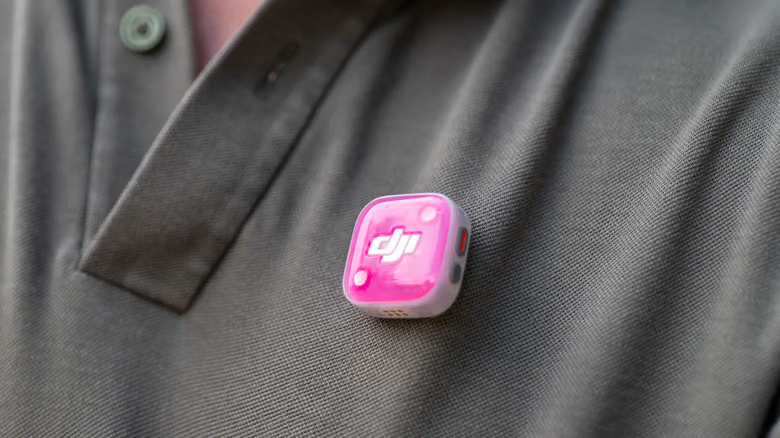
On the design side, the transparent top cover is even more see-through this time, printed with a small "Mini 2S" logo in an orange-and-gray colorway. The power button has switched from clear to orange, and the embossed logo is deliberately raised about 1mm so the included 10-color microphone cover can snap onto it precisely. Dent called this out directly in his review: DJI's logo still shows up on camera, and a lot of pro users simply don't want it in frame — DJI, he argues, should offer an option to cover the logo, even as a paid add-on, because "people would pay for it."
Pricing and Availability
The Mic Mini 2S isn't currently available in the US due to national security restrictions on DJI products, and the company hasn't said whether that will change. It's already on sale in markets like Europe and Canada: the Camera Kit (receiver, two transmitters, charging case) runs CA$265, £169, or €189; the Mobile Kit (receiver, single transmitter, charging case) runs CA$149, £79, or €99. For comparison, the $259 Rode Wireless Pro also supports internal 32-bit float recording and comes with two wired lav mics, the Sennheiser Pro Audio Profile Wireless runs $279, and DJI's own Mic 3 — which has more onboard storage — sells for $277 in the US. When you weigh overall ease of use, sound quality, and compatibility with the DJI ecosystem, the Mini 2S barely has a rival at this price point. The one caveat: if you need broadcast-grade vocal precision, this still isn't your final answer.