Bibigo Salmon Steak (비비고 연어 스테이크) sold 1.4 million units in its first six months on the market. That's not the vague adjective you'd expect from marketing copy—it's a hard number CJ CheilJedang was willing to put out publicly, and it's the real takeaway here: this AI platform isn't making claims first and waiting for products to catch up. Two products already exist with sales figures you can actually check against.
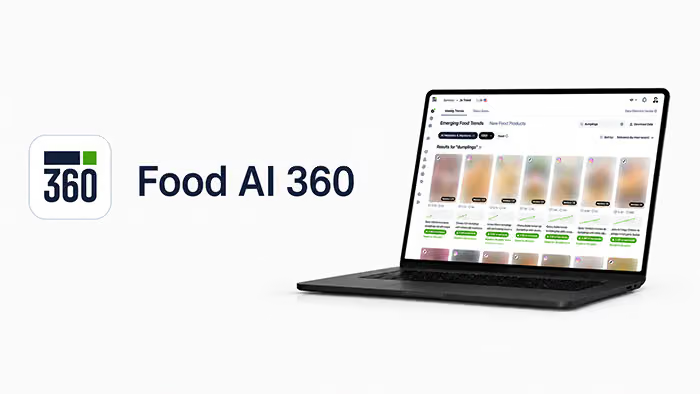
CJ CheilJedang announced on the 6th that its AI platform "Food AI 360" has completed the first step of its global expansion: after being rolled out to its domestic Korean business division last June, the platform completed deployment in the US in late June this year, making it the second market to adopt the system. Developed in-house by the food marketing office and the AX/DX division, the company describes it as the industry's first platform to integrate real-time trend analysis, marketing, product planning and development, and consumer response simulation into a single system. With the US rollout complete, CJ CheilJedang can now analyze the local food market and consumer response in real time, more precisely track K-Food trends on the ground in America, and quickly translate the results into product planning and marketing.
The part of the platform that actually supports decision-making is called "Concept Studio." It takes predicted trends and turns them into concrete product concepts—visualizing product direction, key features, and packaging formats. AI evaluation then previews likely consumer reactions along with a product's strengths and areas needing improvement, giving the planning stage something to base judgment on instead of relying purely on gut instinct.
Matcha Hetbahn (말차 햇반), launched this June, went through exactly this process—confirming that last year's matcha boom still had room to run, and pinning down the product concept of "healthy ingredients plus ready-to-eat convenience" at the intersection of health and convenience demand.
The logic behind Bibigo Salmon Steak is worth unpacking further: the platform picked up on a shift in protein consumption away from white fish and other seafood proteins. Consumption habits that once centered on mackerel—positioned as a "side dish to eat with rice"—are gradually giving way to options like salmon that better fit diet-management needs. The 1.4-million-unit sales figure over six months, in a sense, validates that read on the market.
This AI-driven insight is also being applied to brand extension. CJ CheilJedang has recently expanded its flagship brands—Hetbahn, Dasida, and Bibigo—into new categories like snacks and beverages, giving consumers new ways to engage with the same brands.
CJ CheilJedang says that, starting with the US this year, it plans to roll out Food AI 360 next to Japan, Europe, and other key regions in sequence. A company insider says the platform's goal is to link "trend detection, consumer evaluation, and productization" into a single continuous process, speeding up development and improving the odds of market success. No specifics on launch timelines or investment scale for each region have been disclosed publicly at this point.