The KMT caucus's initial referendum wording crammed in five demands at once—health, power supply, electricity prices, national defense resilience, and AI industry development—reading more like a policy platform than a ballot question. After legislative floor negotiations on the 14th, that laundry list got slashed down to a single sentence: "Do you support the government using 'nuclear power' to revitalize the economy by abolishing the 'nuclear-free homeland' energy policy?" With the trim complete, the question now directly targets scrapping the nuclear-free homeland policy itself, raising the stakes even higher than last year's referendum on restarting Nuclear Plant No. 3.
The legislative floor ultimately passed the measure 59 to 51, with this question joining referendums on "corporal punishment" and "earmarking traffic fine revenue" to form a package of three, all set to be voted on jointly with the nine-in-one local elections on November 28. What was originally pitched as a six-item slate got trimmed at the negotiating table—the TPP caucus's "vote transfer" and "euthanasia" proposals, along with the KMT caucus's "anti-death penalty abolition" measure, all got cut. The reasoning wasn't complicated: cramming in too many questions dilutes mobilization efforts and lengthens voting lines, so the blue-white alliance ultimately chose to concentrate their firepower on the remaining three.
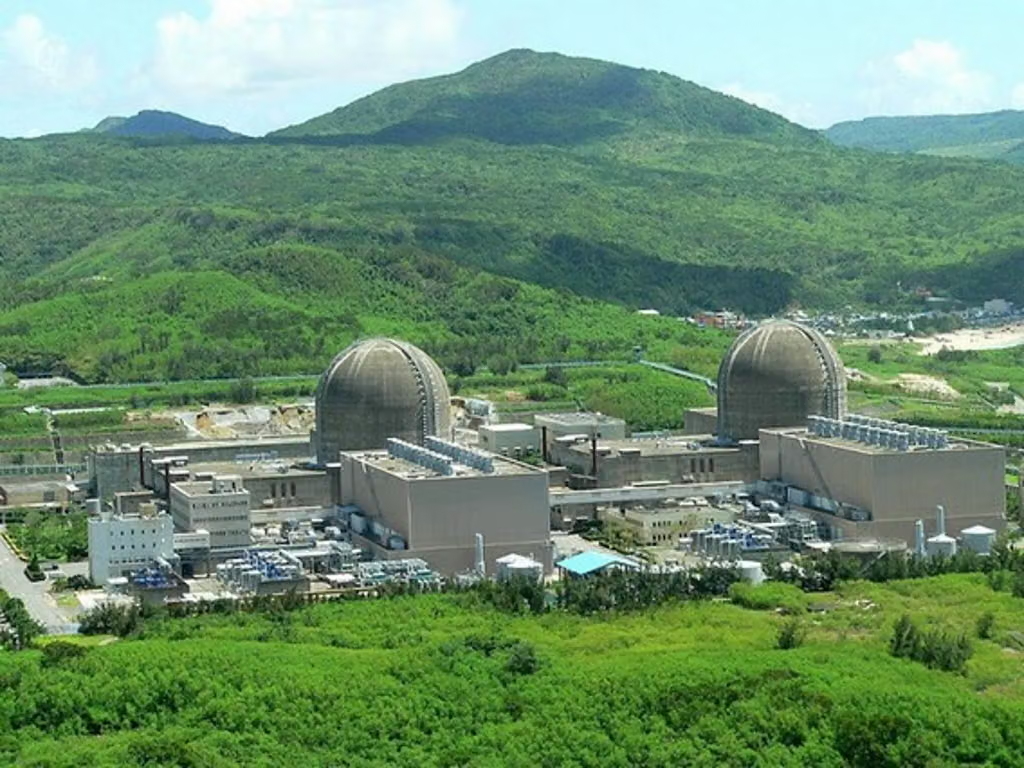
For the referendum to actually take effect, "yes" votes must clear the legal threshold of 4,887,133, and must also outnumber "no" votes. This threshold tripped up last year's referendum on restarting Nuclear Plant No. 3 on August 23: although "yes" votes outnumbered "no" votes, the total still fell short of the required threshold. A year later, the issue is back on the table—but this time with a more direct target. It's no longer just about whether to restart Nuclear Plant No. 3, but whether to dismantle the entire nuclear-free homeland policy altogether.
The KMT caucus's original wording explicitly included a demand to "support AI industry development," pointing to the real wild card behind this referendum: the rapidly ballooning power appetite of AI data centers. Nvidia CEO Jensen Huang, visiting Taiwan last year just ahead of the Nuclear Plant No. 3 referendum, publicly declared that "nuclear is better," directly linking nuclear power to AI factory output. A recent survey by the Taiwan Inspiration Association (TIA) found that 79% of respondents lean toward supporting the reactivation of Nuclear Plant No. 4, and supporters are citing that figure as evidence that the nuclear issue has crossed party lines between the blue and green camps.
Back in March, President Lai Ching-te acknowledged that Nuclear Plants No. 2 and No. 3 "meet the conditions for restart," and Taipower has already submitted a plan to resume operations at Plant No. 3 to the regulatory authority for review—a process that will still take roughly two years to complete at the earliest. In other words, the vote on November 28 won't directly determine when the nuclear plant resumes generating power, but it will serve as a nationwide referendum on whether Taiwan's energy policy is truly about to shift course.