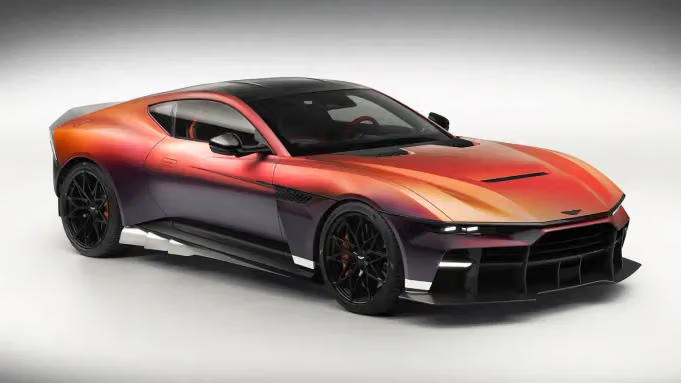
The rear window is gone. Where glass would normally sit on the Aston Martin Valen's tail, a solid carbon fiber tailgate takes its place instead, hiding 170 liters—roughly six cubic feet—of cargo space, an unusual feature for a supercar. The design team laid this decision bare under the lights at a preview event held at the company's Gaydon headquarters in the UK.

Valen is another "alter ego" from the Special Vehicle Operations (SVO) division, joining the small-batch bespoke lineup alongside Valour, Valiant, and DBR22—but this time the experimentation doesn't stop at the bodywork. The car keeps a low cabin and wide track, while the traditional S-curve at the front is interrupted, replaced by a single sharp fold that sweeps across the hood, with a geometric intake grille tucked beneath deeply recessed headlights. Extended side canards pull air from the wheel arches, channeling it back toward the broad rear section and stepped side skirts lined with serrated vortex generators—all these lines building toward a car that looks ready to slice through the air at any moment.

Color was one of the highlights of the preview. SVO's color specialists demonstrated the Satin Andromeda Red finish under studio lighting, where Chromaflair interference pigments shift the car's hue between red, copper, gold, and blue depending on the viewing angle. Exposed carbon fiber panels and 3D-printed parts are all finished with a clear ceramic coating, treating the material's own texture as decoration rather than something to conceal.

The titanium exhaust system at the rear is also 3D-printed, with four tailpipes split into two logics: two low-mounted pipes with valve control, and two high-mounted pipes that stay permanently open. The design team describes the sound principle of the high-mounted pipes as being like a pipe organ, with overall volume across the rev range 50% louder than the brand's standard V12 platform.
Behind the 850PS: Engineers Are Cutting, Not Adding

Under the hood sits a 5.2-liter twin-turbo V12 producing 850PS (838 horsepower) and 1,000 Nm (738 lb-ft) of torque, with peak torque arriving from just 2,500 rpm. Paired with a ZF eight-speed transmission, the shift logic borrows strategy from the Vantage GT4 racing program. The 0-60 mph sprint takes 3.0 seconds, with an electronically limited top speed of 214 mph (344 km/h).

To counter the trend of hybrid-era performance cars carrying heavier bodies, engineers stripped up to 110 kg (242 lbs) from the core chassis: carbon fiber, magnesium alloy wheels, and titanium bolts all play a part, alongside an optional lightweight suspension package weighing 16.9 kg (37 lbs) that uses machined aluminum alloy control arms and knuckles.
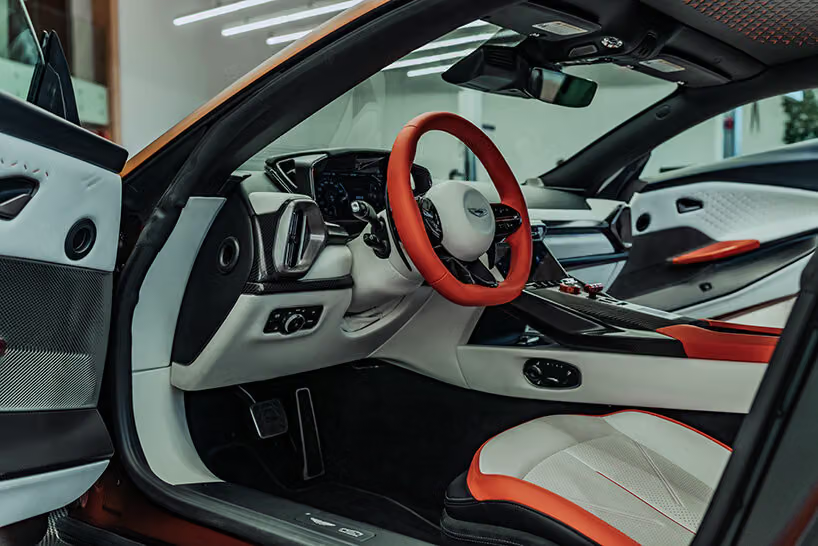
The cabin carries the same subtractive logic. The center console's tilt angle borrows from the Valhalla, with performance switches and the reclined central touchscreen angled toward the driver, supported internally by a 3D-printed titanium lattice structure. Perforated titanium elements recur throughout the cabin, echoing the exterior's cooling vents while shaving weight off functional parts; the air vents have been redesigned to reduce visual clutter, finished with a new color scheme of custom anodized aluminum trim.

Seats come in a choice of Sports Plus or lightweight carbon fiber performance buckets, with interior materials offered in either Semi-Aniline leather paired with Alcantara, or an all-Semi-Aniline leather system, further divided into five configurations—Monotone, Duotone, Light Duotone, Tritone, and Driver Focused, the last of which adds contrast-color detailing only to the driver's seat. The stitching and embroidery thickness on the headrests, headliner, and floor mats shift accordingly, echoing the layered density of the exterior's carbon fiber weave.
The Aston Martin Valen will be limited to 150 units worldwide, with customer deliveries expected to begin in Q2 2027. The public debut is scheduled for The Quail during Monterey Car Week 2026.